Share
What If Waking Up Is Just Realizing Your Old Life No Longer Fits?
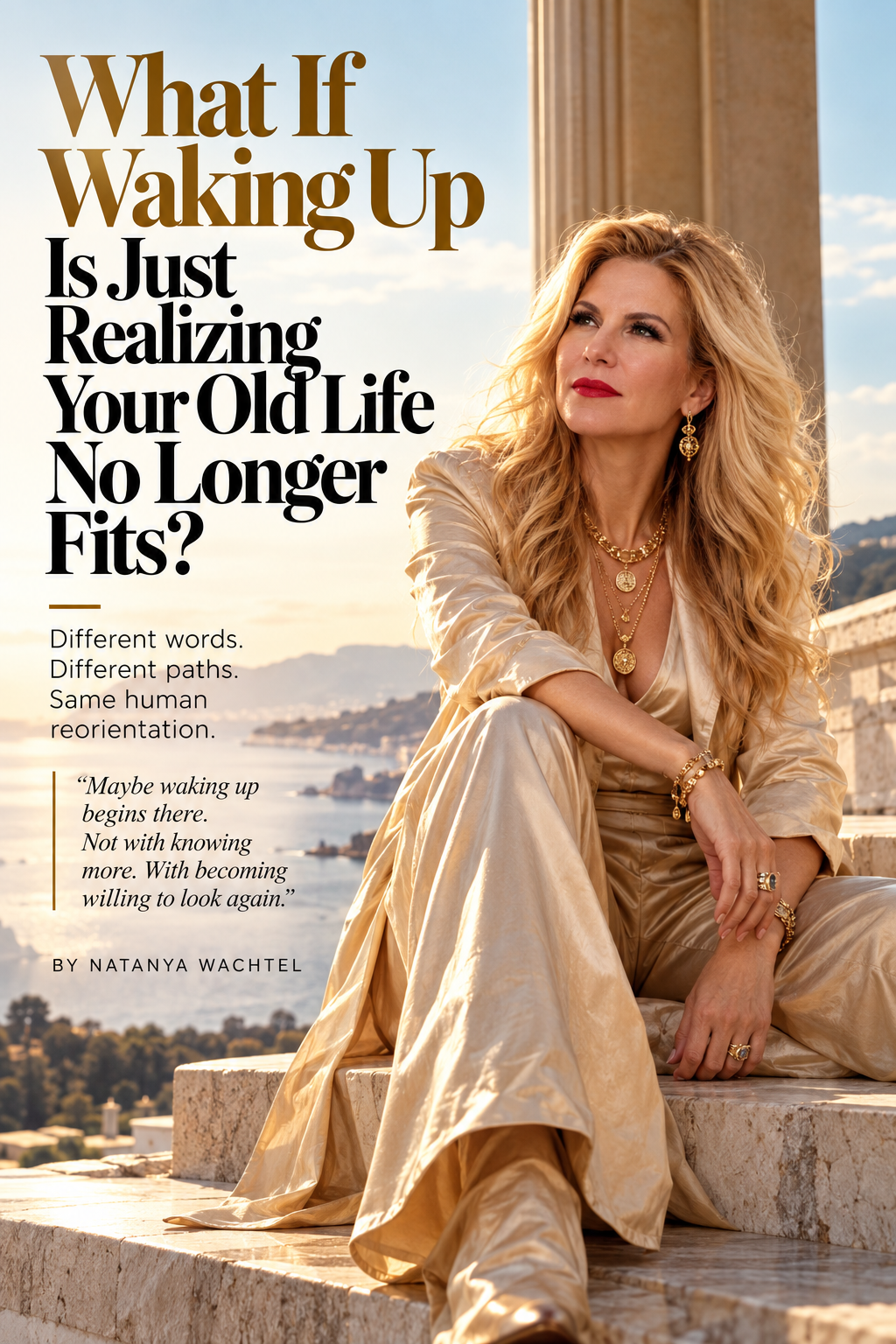
What happens when the organizing logic of a human life stops working—and the old map no longer fits?
Lately, everyone seems to be waking up.
At least that’s what we’re calling it.
Awakening. Alignment. Consciousness. Expansion. Transformation. Soul recognition. Timeline shifts. Sobriety. Recovery. Reinvention. Pick your community and you’ll get a different vocabulary.
Spend enough time in wellness circles and you may hear someone say they’re “shifting into alignment.”Spend time in recovery and someone might simply say, I can’t live like that anymore. A therapist might call it differentiation.
A neuroscientist might talk about prediction, identity and the nervous system. A person leaving a 25-year career might say, I woke up one morning and realized I didn’t believe in any of this anymore.
Someone leaving a marriage may say, We became different people. Someone who nearly died may say something considerably harder to explain.
I’m becoming less interested in deciding which vocabulary is correct. I’m interested in the phenomenon underneath all of it.
What happens when the organizing logic of a human life stops working? Because I don’t think we’re only talking about relationships anymore.
I think we’re talking about a much larger human reorientation.
## COVID Cracked Something Open
There was an enormous involuntary experiment beginning in 2020. Billions of people had their routines interrupted.
Workplaces disappeared overnight. Schools closed. Families were separated—or suddenly confined together. People became sick. People died. Weddings were postponed. Funerals happened through screens. Commutes vanished. Careers changed. Houses became offices, classrooms, gyms, restaurants and sometimes pressure cookers. And when enough of ordinary life disappeared, some people discovered something uncomfortable:They weren’t sure they wanted all of it back.
The psychological consequences were measurable. The World Health Organization estimated that anxiety and depression increased by approximately 25 percent globally during the first year of the pandemic.
In the United States, researchers found something more subtle happening to relationships. Thirty-eight percent of Americans reported feeling less close to friends they knew well than before the pandemic. One-quarter felt less close to close family.
But 22 percent became closer to family.
That’s important.
The disruption wasn’t moving everyone in one direction.
It was revealing things.
COVID didn’t invent every unhappy marriage, meaningless job, neglected friendship, drinking problem, spiritual question or existential crisis. Sometimes it removed enough noise for people to hear what had already been whispering.
And I wonder whether we’re still living inside that recalibration.
## The Divorce Statistics Aren’t Actually the Story
It would be convenient to point to divorce rates and announce that everyone is breaking apart.
Except that isn’t what the data say.
The U.
S. divorce rate has actually declined considerably over the past several decades. Internationally, there isn’t one global divorce trajectory either. Across OECD countries, divorce rates rose in some places and fell in others between 1990 and 2022. Marriage itself has changed considerably, with marriage rates generally declining across many developed countries.
So perhaps the interesting story isn’t:Everyone is leaving.
Maybe it’s:Everyone is examining.
And examination doesn’t always produce separation.
Sometimes people leave.
Sometimes they stay differently.
Sometimes a marriage becomes more honest. Sometimes a friendship becomes family.
Sometimes a friendship ends.
Sometimes someone we assumed would be temporary becomes foundational. Sometimes a person we’ve known for 30 years suddenly feels like someone from another lifetime.
And sometimes the relationship being renegotiated isn’t with another person at all.
It’s with work.
Money.
Alcohol.
Religion.
Power.
Our bodies.
An institution.
Our identity.
Or the person we thought we were supposed to become.
## What Does “Waking Up” Actually Mean?
I have become suspicious of this phrase. Not because I think nothing meaningful is happening.
Because I think something is happening, and the language has become too sloppy to hold it. “Woke.”“Awakened.”“High vibration.”“Conscious.”“Aligned.”These words can mean almost anything.
Worse, they can become status claims.
I’m awake and you’re asleep.
That isn’t consciousness.
That’s hierarchy wearing linen.
I’ve met people who can speak exquisitely about consciousness and behave terribly toward actual conscious beings.
So I’m trying a different definition.
Maybe waking up is simply the moment when something you can no longer unknow makes your previous arrangement impossible to inhabit in quite the same way.
That doesn’t require incense.
It happens in recovery rooms every day. A person gets sober and discovers that an entire social architecture was organized around drinking.
They haven’t merely removed alcohol.
Friendships may change.
Weekends change.
Marriage changes.
Sex changes.
Their nervous system changes.
Their understanding of themselves changes. In 2024, 23.5 million American adults who said they had experienced a problem with drugs or alcohol considered themselves in recovery or recovered.
That’s millions of people potentially renegotiating not merely a substance, but a relationship with identity. Maybe that’s an awakening too.
## Death Has Its Own Vocabulary
Mine came through death.
Or very close to it.
I had an experience more than a year ago that reorganized things I am still trying to understand. And that is about as much detail as I need to give you.
Because the point isn’t whether you interpret what happened to me spiritually, neurologically, psychologically or some combination of all three. The point is that I couldn’t return to exactly the same perceptual architecture afterward.
And I tried.
That’s the part we don’t talk about enough. We love transformation stories after they’ve been edited.
Before.
Catastrophe.
Revelation.
After.
Three acts. Beautiful lighting.
Transformation in real life can be irritatingly slow. Mine has taken more than a year, and I’m not convinced it’s finished.
Some things that once mattered enormously matter less.
Some people became closer.
Others became more distant.
Some professional ambitions survived.
Others suddenly looked like artifacts belonging to somebody I remembered being. And some relationships became harder to categorize rather than easier.
I started asking questions I couldn’t put back in the box.
## Who Gave You Your Authority?
Recently, while exploring breathwork, contemplative traditions and embodied practices, I encountered the story of Yeshe Tsogyal, one of the great female figures of Tibetan Buddhist tradition. That eventually led me back to Mary Magdalene.
Two radically different traditions.
Two radically different women.
I’m not collapsing them into the same story. What interested me was a question underneath both:Where does human authority come from?
From the powerful person beside us?
From the institution that credentials us?
From the organization employing us?
From the teacher?
From the spouse?
From the government?
From the intelligence community?
From the university?
From the spiritual leader?
From the corporation?
Or from what we have actually experienced, examined, tested and come to understand?
None of us becomes ourselves alone.
Teachers matter.
Partners matter.
Institutions matter.
Mentors matter.
Extraordinary people can alter the trajectory of our lives. But support and authorship are different things.
Perhaps one of the most loving things another human can do is help us become more ourselves without needing to become the explanation for who we became.
## Institutions Wake Up Too—Or We Wake Up Inside Them
I think this applies to careers more than we’re willing to admit. You can spend decades working inside an institution whose stated values sound remarkably similar to your own.
Public service.
Health.
Justice.
Innovation.
Security.
Human flourishing.
Truth.
Impact.
Then one day you notice a gap between the values on the wall and the incentives in the room.
That can happen inside a corporation.
A nonprofit.
Healthcare.
Academia.
A religious institution.
Government.
An intelligence organization.
Even an organization you helped build. And then comes an exquisitely uncomfortable question:Do I still belong here because I believe in what this institution does—or because belonging here has become part of who I believe I am?
That isn’t necessarily evidence that the institution is corrupt.
Sometimes we changed.
Sometimes it changed.
Sometimes both happened.
But once we perceive the discrepancy, we have another decision to make. That is also a relationship.
## Soul Recognition—or Psychology?
Then there are people.
This is where things get particularly interesting. Some traditions describe “soul recognition”: meeting someone and experiencing an immediate, disproportionate sense of familiarity or significance.
Psychology offers plenty of possible mechanisms.
Attachment.
Projection.
Transference.
Pattern recognition.
Similarity.
Self-expansion.
Nervous-system responses.
Memory.
Chemistry.
None of those explanations make an encounter meaningless. And the language of soul recognition doesn’t establish that something supernatural occurred.
I’m becoming increasingly comfortable leaving some things unresolved. Something can be phenomenologically real without my explanation for it being objectively correct.
That’s an important distinction.
I can say:Something happened when I met you. Without saying:Therefore the universe assigned you to me.
That has changed how I think about relationships enormously. A profound connection doesn’t automatically require sex.
Sex doesn’t automatically require partnership. Love doesn’t automatically require possession.
A marriage can coexist with meaningful relationships with other humans. A platonic friendship can contain extraordinary intimacy.
Someone can awaken something in us without being entitled to the thing they awakened. Someone can transform our lives without being meant to remain in them forever.
And perhaps most importantly:Intensity is information. It isn’t instruction.
## False Flags
This is where discernment becomes essential. Because every cultural shift attracts people who learn the vocabulary faster than the ethics.
There are false flags everywhere.
People who speak alignment without accountability. People who preach consciousness but cannot tolerate disagreement.
People who teach boundaries but violate everyone else’s. People who sell healing while manufacturing dependency.
People who talk about freedom while requiring followers. People who mistake certainty for wisdom.
But this isn’t only about gurus or influencers.
Organizations do it.
Brands do it.
Governments do it.
Families do it.
And we do it to ourselves.
We create stories explaining why we are good, aligned, evolved, indispensable, enlightened or right. Then we selectively collect evidence supporting the story.
That’s why I don’t think awakening means becoming certain. I increasingly think it means becoming harder to fool—including by yourself.
## Maybe We Are Shifting Worlds
Not literally.
Or perhaps literally, depending on your cosmology.
I don’t need to settle that question.
But there is a perfectly ordinary sense in which human beings shift worlds all the time. Get sober and you enter another world.
Become a parent and you enter another world.
Lose a parent and you enter another.
Leave a religion.
Change careers.
Survive cancer.
Lose a spouse.
Fall in love.
Come out.
Transition.
Get divorced.
Recover from an illness.
Nearly die.
Move countries.
Lose everything.
Build again.
You can remain in the same geographic coordinates while the world you inhabited yesterday becomes inaccessible. The people around you may still be living there.
That’s where transformation gets lonely. WHO now estimates that roughly one in six people worldwide experiences loneliness.
Perhaps some loneliness comes not simply from having too few people around us, but from experiencing too little recognition between us. Do you see the world I’m standing in now?
Can I still see yours?
Can we remain connected if they’re no longer exactly the same?
## What Remains?
This is where the number seven has been following me. I don’t treat numbers as instructions from the universe.
I treat symbols as invitations to inquiry. And lately seven has become a useful container for one question:What remains?
When the job title disappears, what remains? When the institution no longer validates us, what remains?
When the marriage changes, what remains? When a friendship changes form, what remains?
When attraction isn’t acted upon, what remains? When alcohol disappears, what remains?
When the children grow up, what remains?
When the body changes, what remains?
When the worldview we inherited can no longer explain our experience, what remains?
When someone dies—what remains?
And when the person we were before all of it becomes increasingly difficult to locate—who remains?
Maybe that’s waking up.
Not becoming enlightened.
Not ascending.
Not discovering that we’re more spiritually evolved than everyone else. Maybe consciousness is partly the increasingly uncomfortable capacity to notice when our external arrangements no longer correspond to our internal understanding—and then resist both temptations:to destroy everything impulsively,or to pretend we never noticed.
There is an enormous territory between those two responses.
We can examine.
We can question.
We can stay.
We can leave.
We can renegotiate.
We can ask for evidence.
We can tolerate ambiguity.
We can love people whose paths diverge from ours. We can allow ourselves to be changed by people without surrendering ourselves to them.
We can recognize the institutions and people who supported our becoming without handing them authorship of who we became. And maybe we can stop demanding that every transformation immediately explain itself.
I’m still examining mine.
More than a year later, perhaps that’s the point. I don’t know whether humanity is undergoing some grand collective awakening.
That’s a very large claim.
But I do know that millions of us have experienced disruption profound enough to make old assumptions visible. And once an assumption becomes visible, we have a choice.
We can defend it because it is familiar.
Or we can examine it.
Maybe waking up begins there.
Not with knowing more.
With becoming willing to look again.