Share
Consciousness has a branding problem
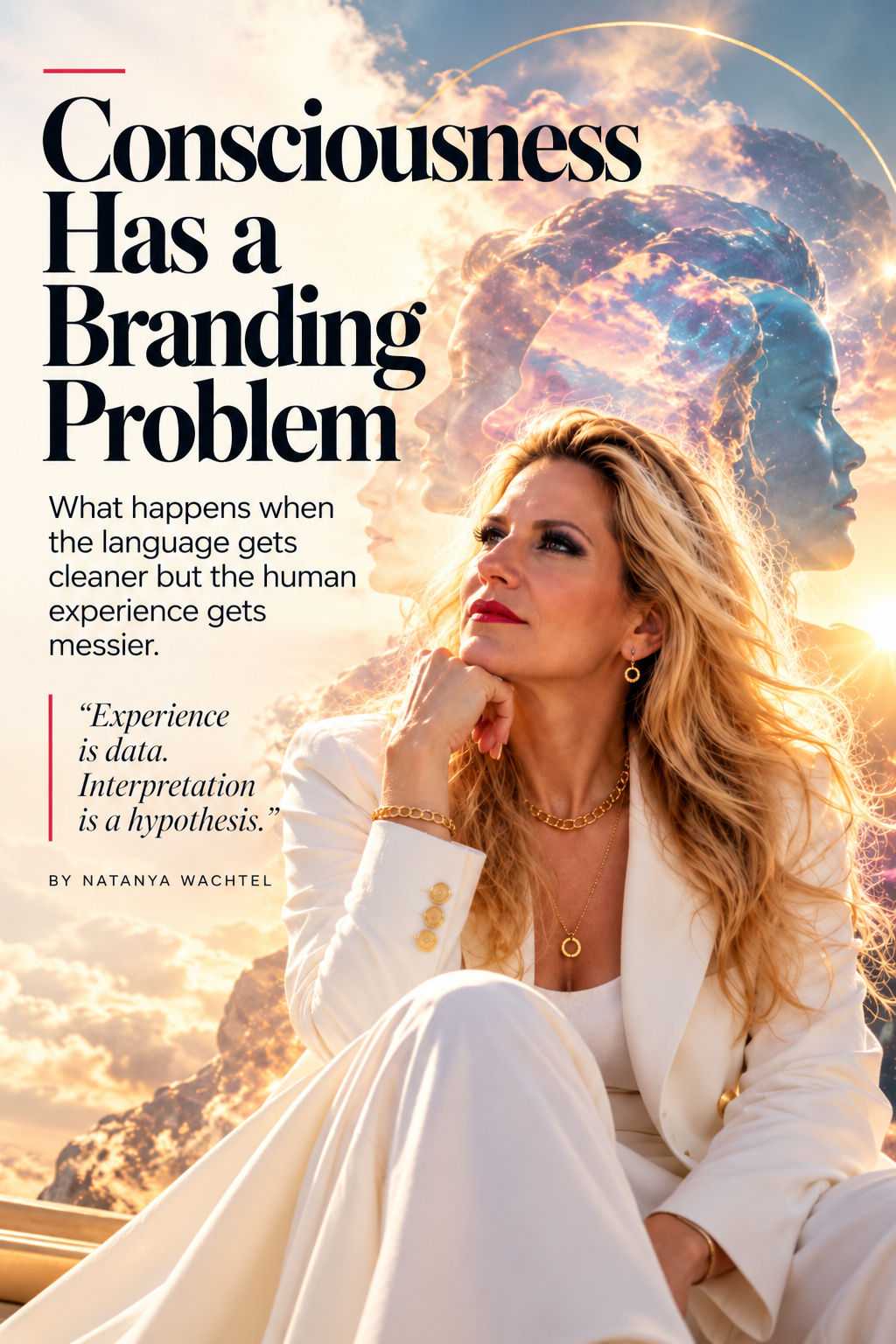
What if “waking up” is less about enlightenment—and more about realizing the old map no longer fits?
Everyone seems to be waking up.
Which is becoming a problem.
Awakening. Alignment. Expansion. Higher consciousness. Soul recognition. Energetic shifts. Authenticity. Transformation. Living your truth.
We have developed an extraordinary vocabulary for becoming more conscious.
I am increasingly unsure that using the vocabulary means we are doing any of it.
Consciousness has a branding problem.
We have made it an aesthetic. It has retreats and podcasts and supplements and breathwork and ice baths. It has vocabulary. It has influencers. It has algorithms. It has extremely good lighting.
And underneath all that branding, I think something genuinely interesting may be happening.
Not necessarily metaphysical.
Human.
A lot of us seem to be renegotiating the organizing principles of our lives: our relationships, careers, institutions, bodies, beliefs, substances, definitions of success, understanding of intimacy—even our confidence in how we know what we know.
Maybe we are not all “ascending.”
Maybe we are reorienting.
And I think that is considerably more interesting.
SHIFT HAPPENS
I keep coming back to a very inelegant phrase that may be more useful than “awakening”:
Shift happens.
Sometimes we choose it. Sometimes our bodies choose it for us. Sometimes the world changes and takes our familiar architecture with it.
The shift itself is only the beginning.
The harder question is what happens afterward.
What do we keep? What stops fitting? Which relationships deepen? Which identities suddenly feel like old clothes? Which beliefs survive contact with what we have actually experienced?
That is the territory I am increasingly interested in—not the Instagram version of transformation, but the reorganization that follows it.
SOMETHING HAPPENED TO US
COVID is an obvious place to begin.
For a period of time, billions of people were forced out of the architecture that had made ordinary life feel ordinary. Commutes disappeared. Offices disappeared. Schools closed. Families were separated or suddenly confined together. People became sick. People died. Weddings were postponed. Funerals happened through screens. Kitchen tables became classrooms and conference rooms. Time got weird.
The World Health Organization estimated that global prevalence of anxiety and depression increased by about 25 percent during the first year of the pandemic.
And years later, social disconnection remains a serious public-health issue. In 2025, the WHO Commission on Social Connection reported that roughly one in six people worldwide experiences loneliness.
Those numbers do not prove that humanity is “waking up.” They do tell us that disruption and disconnection have occurred at enormous scale.
And when the machinery started again, some people discovered something uncomfortable:
I do not want all of it back.
COVID did not invent every unhappy relationship, meaningless job, drinking problem, neglected friendship, spiritual question or existential crisis.
Sometimes it removed enough noise for people to hear what had already been whispering.
THE DIVORCE STORY ISN’T THE STORY
It would be convenient to point to divorce and announce that everyone woke up and left.
The data do not cooperate.
In the United States, the provisional divorce rate was 2.4 per 1,000 people in 2023, down substantially from 4.0 per 1,000 in 2000. Across OECD countries, the longer-term picture is mixed: between 1990 and 2022, crude divorce rates rose in 13 countries and fell in 16.
That is more interesting than a neat cultural panic.
Maybe the story is not mass separation.
Maybe it is mass examination.
Some people leave.
Some stay differently.
Some renegotiate marriages.
Some friendships become family.
Some friendships end.
Some people discover that a career they worked decades to build no longer represents what they value.
Some get sober and realize that removing the substance also rearranges Tuesday night, sex, friendship, anxiety, ritual and identity.
Some survive something and discover that survival itself does not tell them how to live afterward.
The shift is one event.
Reorientation is another.
WHAT DOES “WAKING UP” EVEN MEAN?
This is where I start getting irritated with the language.
“Awakening” now covers everything from surviving cancer to buying a crystal.
Those things are not equivalent.
Someone gets sober after 15 years and says, “I woke up.”
Someone leaves a religion that structured their entire worldview.
Someone comes out.
Someone transitions.
Someone gets divorced.
Someone stays married but completely renegotiates the marriage.
Someone becomes a parent.
Someone loses one.
Someone changes careers at 50.
Someone realizes that the organization they have served for decades does not actually operate according to the values they thought they shared.
Someone undergoes an experience they understand as spiritual.
Someone else has a profound psychedelic experience.
Someone spends five years in therapy and finally sees the pattern they have been repeating since childhood.
Someone nearly dies.
These are not the same events.
But perhaps they sometimes share an architecture.
There was a before.
Something happened that the existing model could not adequately explain.
And then there was an after.
The difficult part is everything that happens next.
MINE INVOLVED DEATH
My own reorientation involved coming very close to death.
The experience itself happened quickly.
Living differently because of it has taken more than a year.
That distinction matters because we have turned transformation into another before-and-after photograph.
Before.
Catastrophe.
Revelation.
After.
Beautiful lighting.
Real transformation, at least in my experience, has been considerably less cooperative.
It has involved examining relationships. Work. My body. My priorities. People I feel unexpectedly connected to. People I no longer experience in quite the same way. Things I thought mattered enormously. Things I did not realize mattered at all.
And perhaps most unsettlingly, it has required examining my own explanations for what is happening to me.
Because having an extraordinary experience does not automatically make my interpretation of that experience correct.
EXPERIENCE IS DATA. INTERPRETATION IS A HYPOTHESIS.
Recently I have been exploring breathwork, contemplative traditions, embodied practices and older systems that have asked questions about human consciousness for centuries.
That has included learning about traditions such as Tibetan tantra—not because I suddenly believe an ancient system contains all the answers, but because I am fascinated by the questions humans keep asking.
What do we do with desire?
Fear?
Attachment?
Grief?
Power?
Altered states?
Intuition?
The sensation that another person is somehow profoundly familiar?
Different traditions offer different explanations. Psychology has others. Neuroscience has others.
I do not think intellectual maturity requires choosing a team before we have finished looking.
I have started using a simple distinction:
Experience is data. Interpretation is a hypothesis.
I can say, “Something extraordinary happened to me,” without saying, “Therefore I know what caused it.”
I can say, “Something changed when I met this person,” without saying, “Therefore the universe assigned this person to me.”
I can acknowledge intuition without pretending intuition is infallible.
I can respect science without pretending science has already answered every question worth asking.
That middle territory is less marketable.
It is also where I am increasingly comfortable living.
SOUL RECOGNITION OR NERVOUS SYSTEM?
Take “soul recognition.”
It is a beautiful phrase.
Sometimes we meet another human being and experience a wildly disproportionate sense of familiarity or significance.
Spiritual traditions may call versions of this resonance, karma, destiny or recognition across lifetimes.
Psychology might ask about projection, transference, attachment, similarity, pattern recognition or self-expansion.
Neuroscience might ask what the brain and autonomic nervous system are doing before conscious interpretation catches up.
Why must I immediately choose?
Something happened.
That is the first fact.
What it means is the investigation.
And perhaps that distinction could save us from a tremendous amount of unnecessary chaos.
Intensity is information. It is not instruction.
You do not have to sleep with someone because the connection is profound.
You do not have to leave your marriage because someone awakened something in you.
You do not have to remain in a friendship because it once felt essential.
You do not have to turn synchronicity into destiny.
And you do not have to dismiss an extraordinary encounter because you cannot explain it.
You can observe.
That is remarkably difficult for humans.
THE FALSE FLAGS
This is where consciousness has its biggest branding problem.
We have learned how conscious people are supposed to sound.
Alignment. Boundaries. Holding space. Authenticity. Energy. Trauma-informed. Purpose. Higher self. Healing.
Those can be useful concepts.
They can also become costumes.
I have encountered people who can speak fluent consciousness and behave unconsciously as hell.
People who preach boundaries but do not respect anyone else’s.
People who teach empowerment while creating dependency.
People who talk about abundance while exploiting people.
People who use “energy” to avoid evidence.
People who call criticism “low vibration.”
People who confuse certainty with enlightenment.
But false flags do not only exist in wellness culture.
Corporations have them.
Institutions have them.
Nonprofits have them.
Religions have them.
Governments have them.
Families have them.
We have them.
A company can put its values on a wall and incentivize the opposite behavior.
A person can build an entire career inside an institution—corporate, academic, governmental, intelligence, healthcare, nonprofit—because its stated mission appears to correspond with their values.
Then one day they notice the gap.
Maybe the institution changed.
Maybe they changed.
Maybe they finally noticed something that had always been there.
That is a consciousness problem too.
THE WORK SHOULD LEAVE EVIDENCE
Recovery communities understood something long before “transformation” became an industry.
Changing consciousness is not primarily about what you realize.
It is about what happens after the realization.
Getting sober is not merely, “I realized alcohol is hurting me.”
It is Tuesday night.
It is the friend group.
It is dinner.
It is sex.
It is boredom.
It is anxiety.
It is identity.
It is what you do at 6 p.m.
It is who still calls.
It is who does not.
The revelation can happen in a moment.
Reorganization takes time.
That resonates deeply with me.
The branding is instantaneous.
The work leaves evidence.
So I am developing a less glamorous consciousness test.
Can you tolerate being wrong?
Can you change your mind without experiencing it as annihilation?
Can you apologize?
Can you hold a boundary without punishing someone?
Can you respect another person’s boundary when it disappoints you?
Can you experience attraction without turning it into entitlement?
Can you love without possessing?
Can you leave something without needing to demonize it?
Can you stay somewhere without abandoning yourself?
Can you encounter information that threatens your identity and remain curious?
Can you distinguish what happened from the story you built around what happened?
Can you say:
I don’t know?
That may be one of the most conscious sentences available to us.
MAYBE WE ARE CHANGING WORLDS
Not necessarily in the metaphysical sense.
In the very ordinary human one.
Get sober and you enter another world.
Become a parent.
Lose a parent.
Fall in love.
Fall out of love.
Come out.
Transition.
Lose your health.
Recover it.
Lose your career.
Leave your religion.
Survive something you did not expect to survive.
Move countries.
Lose money.
Make money.
Watch your children grow up.
Nearly die.
The geographic coordinates can remain identical while the world you occupied yesterday becomes inaccessible.
And sometimes the people we love are still living there.
That is where transformation gets lonely.
Not because one person is “awake” and another is “asleep.” I hate that hierarchy.
Maybe we are simply standing inside different models of reality.
The harder question is whether we can remain curious about each other’s worlds without requiring either person to surrender their own.
WHY I’M EXAMINING THIS NOW
This is also why these questions are increasingly showing up in what I am building.
Not because I woke up one morning and decided “consciousness” would make a good market category.
Quite the opposite.
The work kept bringing me back to the same human problem from different doors.
In behavioral science: how do people make meaning and change behavior?
In wellness: what happens when regulation changes what we are able to perceive and choose?
In Human Decoder: what happens when we become curious about our own patterns instead of simply obeying them?
In The Natanya Experience and Beyond the Psyche: what do we do with experiences that do not fit neatly inside one explanatory framework?
Across New Solutions Network, the common thread is not proving a spiritual worldview.
It is human reorientation.
Identity under pressure.
Meaning versus evidence.
Connection.
Choice.
The moment an inherited answer stops working and someone has to ask a better question.
That is why I am examining this now.
Because I am living it.
Because I keep meeting other people who are living versions of it.
And because I think we need language that allows us to investigate transformation without immediately turning it into either pathology, prophecy—or a sales funnel.
Shift happens.
The question is what we do next.
SEVEN: WHAT REMAINS?
Lately the number seven has been following me around.
I am not using it as evidence that the universe has sent me instructions.
I am using it as a prompt.
One question emerged from my conversations around seven that I have not been able to shake:
What remains?
Strip away the title.
What remains?
Strip away the institution.
The substance.
The relationship category.
The money.
The status.
The certainty.
The spiritual vocabulary.
The person who validated you.
The version of yourself everybody else recognizes.
What remains?
Maybe that is what I have actually been doing for the past year.
Not awakening.
Not ascending.
Not becoming enlightened.
Removing things and seeing what survives.
And maybe something larger is happening culturally too.
COVID removed enormous pieces of ordinary life and forced millions of us to look at what remained.
Some rebuilt exactly what they had before.
Some could not.
Some did not want to.
Some of us are still figuring it out.
I do not know whether humanity is undergoing a collective awakening.
That is an enormous claim with terrible branding.
But I do think a lot of people are reconsidering the agreements they made with their lives.
And I think that is worth examining without immediately turning it into either pathology or prophecy.
Maybe consciousness is not knowing that you have awakened.
Maybe it is noticing more.
Testing more.
Performing less.
Becoming a little harder to fool.
Especially by yourself.
And becoming increasingly willing, when the evidence changes, to look again.
Sources / fact-check notes
- World Health Organization, “COVID-19 pandemic triggers 25% increase in prevalence of anxiety and depression worldwide,” March 2, 2022.
- World Health Organization Commission on Social Connection, 2025: roughly 1 in 6 people worldwide experience loneliness.
- CDC/NCHS, provisional U.S. marriage and divorce rates, 2000–2023: divorce rate 2.4 per 1,000 in 2023; 4.0 per 1,000 in 2000. Note: 2023 divorce reporting covers 45 states and D.C.
- OECD, Society at a Glance 2024: between 1990 and 2022, crude divorce rates increased in 13 OECD countries and decreased in 16; marriage rates generally declined over the period.