Share
When Usefulness Becomes the Measure of a Human Being
Before I begin, it matters to say why I’m writing this — and why I’m allowed to. I’m writing as someone who has known Jason Appel for decades: as a former manager, mentor, collaborator, business partner, and friend. Jay helped shape how I think, how I work, and how I lead.
We built things together. We argued. We laughed.
We stayed in conversation through moments that were professionally formative and personally hard.
I asked Jay directly if I could write this — not rhetorically, explicitly. I was nervous. I told him I had even dreamed about writing it and worried that alone disqualified me. We laughed. He agreed, with a clear boundary we share: keep it clean. No sentimentality. No exploitation. No performance. This is written with his knowledge, consent, and care.
There are people in every industry — and every family — who quietly hold everything up…..Not always the loudest voices….Not always the most visible.
The scaffolding humans.
The translators.
The stabilizers.
The ones who carry institutional memory, cultural coherence, and relational glue. We don’t always know who they are until their hands can’t hold the same weight.
Jay is one of those people.
He is a foundational architect of modern digital pharma. Many learned from him at Sanofi, Amgen, Bristol-Myers Squibb, and The Bloc. He didn’t just execute digital strategy — he helped define what it meant. He built systems, teams, and ways of thinking that outlasted individual roles.
In mid-2024, Jay was diagnosed with a brain tumor after some other cancer issues had already surfaced. The surgery itself carried serious mortality risk. He survived — and the aftermath changed him. Communication became more effortful. Expression slowed. For a time, he needed help with basic functions he once handled for others.
But Jay is still here.
He understands. He receives. He responds. He is conversational again. His intellect has not disappeared. Accessing it now requires something our culture treats as optional: patience without a transaction. This is where the fracture shows up. People ask me often, how Jay is.
But they don’t ask Jay.
It isn’t cruelty. It’s avoidance dressed up as etiquette. People don’t know what to say. They’re afraid of saying the wrong thing. They don’t know how to relate without fixing. In professional circles — especially among men — emotional proximity without utility can feel destabilizing.
So we do what many organizations do when confronted with disruption they haven’t designed for: we go quiet.
We talk around people instead of to them.
We wait for a “return to normal” before re-engaging.
We tell ourselves we’re giving space.
Meanwhile, the person still living inside the body in front of us becomes a rumor. That silence is not neutral. It changes the room. It changes what people believe will happen to them if they ever lose capacity, fluency, speed, or status. It teaches people that belonging is conditional, that relevance can expire, that identity is tethered to output.
This is leadership terrain, whether we admit it or not.
Most institutions are built for continuity, not alteration. They reward fluency, speed, and output. They are deeply uncomfortable with cognitive, physical, or emotional variance — especially when it appears mid-career, mid-identity, mid-contribution.
So when someone breaks the pattern, the system doesn’t know where to place them. Not formally. Quietly. Fewer invitations. Fewer calls. Fewer moments of relevance. No explicit decision — just drift.
Leaders should hear this clearly: drift is a decision.
A culture decision. A risk decision. A trust decision.
Because when we let someone like Jay vanish socially, we aren’t only hurting a human being. We are burning institutional memory. Weakening mentorship pipelines. Teaching high performers that they are valued only while they are useful. Training a future workforce to hide injury, hide struggle, and pretend their lives don’t exist outside performance. I think that may be closer to something like fear with better branding rather than ‘classic resilience’.
Over the past six months, I’ve been recovering from a brain injury ( from a traumatic public event) of my own. I am not equating experiences. But I have learned how quickly cognitive disruption gets interpreted as absence.
Words can get stuck. Thoughts can collide. The instrument you’ve relied on your whole life can stop responding the way it used to. What creeps in isn’t always sadness, though of course there is that, and rage and more….It can be disorientation.
A low-grade identity vertigo. The private question beneath the mechanics of surviving: Who am I to my world, after this?
Jay is living inside that question. I am too, albeit differently. And if we’re honest, many of us will too, eventually — through illness, age, burnout, caregiving, layoffs, or reinventions we didn’t ask for.
This is where the stakes widen beyond one friendship, one diagnosis, one industry. We are entering a period where AI and automation will strip “usefulness” away from millions of people faster than their identities can catch up.
Jobs will change faster than self-concept. Roles will collapse. Titles will evaporate. Productivity will be redefined by machines that don’t need sleep or dignity. If output is our only framework for human worth, we are about to injure a lot of people — quietly, efficiently, and at scale.
That’s why I’m sharing this-that maybe a story is useful. Maybe it can bring people together and to show care more freely, and to remember what it means to be human as we navigate today and if we’re lucky, tomorrow.
Because presence is not a soft concept to me anymore. I studied math and science so I feel I can argue as much to suggest that presence is actually, a hard skill.
Staying connected when someone changes is not charity, mind you. For me, it is how trust survives disruption or how culture proves it’s real. Or maybe it is an analog for how it looks when leadership stops being performance and becomes practice and without ultimatum.
So here is the invitation — clean, specific, human: If there is someone you keep asking about instead of asking to, please reach out.
If you don’t know what to say, say that.
If it’s awkward, let it be awkward.
If you’re waiting for them to sound like themselves again, please stop making that the price of admission.
And if this landed because you’re the one who has changed —
or you love someone who has — or you are quietly afraid of being less useful someday — you can always message Jay or me.
Not for spectacle. For coherence. For relief. For the permission to be a whole person in a world that keeps trying to reduce us to outputs.
I don’t have a neat way to end this…I’m not asking for applause or agreement. I’m asking for more patience and care — with ourselves first, and then with each other — about how we treat people when their capacity shifts in any measure of word, and the mirror stops reflecting them back the way it used to.
The Jay that is him now, is here now. The me that I am now, is here now.
And I’m quite sure many of us are navigating versions of this same question in real time, too. Please consider accepting that when staying connected feels uncomfortable, it’s not always a signal to retreat.
Thank you for staying to the end of this show and tell with me.
Xoxoxoox
NW
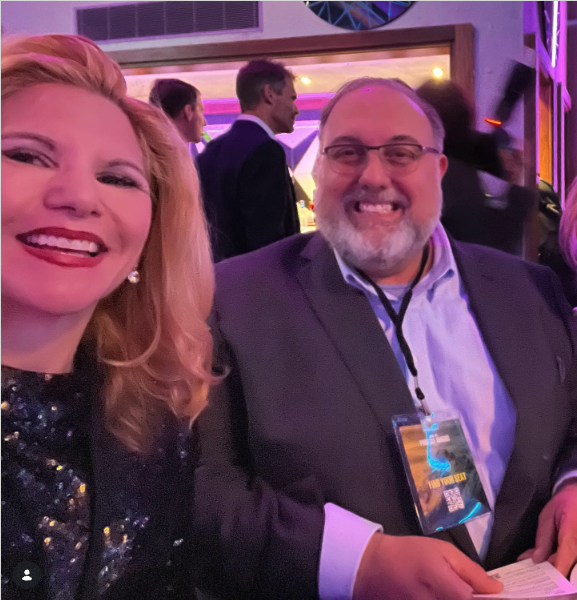
PS My first Instagram post was this photo of Jay and I at the 2022 inaugural MM+M – Medical Marketing and Media Pinnacle Awards where Jason was honored with a Lifetime Achievement award for his contribution to Life Sciences Digital Innovation and Leadership